
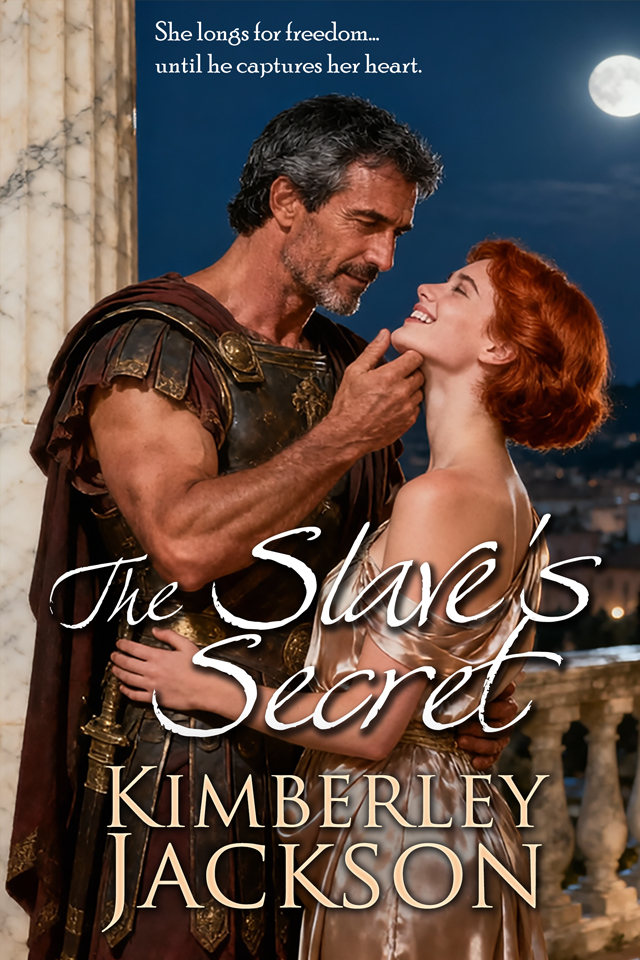
The drawer for The Slave's Secret
Behind the scenes of Samara and Marcus's world and relationship.
From The Wild Rose to The Slave's Secret - The Development of a Novel
From the moment I started writing the first words to the final book that you can now purchase on Amazon.
The first idea for The Slave’s Secret came to me in 2007, which seems like a lifetime ago now.
Back then, I didn’t call the story The Slave’s Secret yet. It wasn’t even an original novel. It started as an NCIS fanfiction set in ancient Rome.
That may sound like an unusual beginning, but for me, it is actually quite typical. Even now, I often write my original stories as transformative works first. Over the years, this has become part of my creative process. It gives me a familiar emotional blueprint for writing strong male and female lead character, even if those characters then end up not having much in common anymore with the characters I originally based them on.
One of the reasons I have developed this process is that, as a reader, I have always struggled with how women are written in romances, especially those with D/s power dynamics.
Especially before the 2010s, but still sometimes today, it was difficult to find strong female characters in BDSM romance who eventually take the submissive role without being written as passive, naive, or weak from the start. There is always the temptation to create a heroine who is “naturally” submissive from the very beginning. But to me, those characters often read very flat and in consequence, they usually come with a rather weak male character as well. I prefer to portray submission as a complex, deliberate, emotionally charged choice that can exist as a need beside her independence.
Because real life has taught me that this is usually what a lot of submissive women (and men) feel.
Many people of all genders who enjoy submission in a sexual or romantic context are strong, capable, opinionated, ambitious, and independent in every other part of their lives. They often have successful careers, responsibilities, sharp minds, and strong boundaries. The stereotypical “Anastasia Steele”—the woman who is submissive and obedient in every aspect of her life—is, in my experience, quite rare.
So this is precisely the type of female character I aspire to write: strong, independent and fully capable of making her own choices. Not because that’s the only type of submissive woman out there, but because I, as a reader, feel like I want to read more stories with characters like her.
Writing a strong female character who eventually submits not only requires emotional complexity in the heroine, it also requires an emotionally mature and self-aware male lead who is strong enough, secure enough, and emotionally stable enough not to feel threatened by her.
Nothing reads as more dominant than a man who is not intimidated by female strength. That is one of the reasons I often struggle with certain dominant male characters in BDSM romance and dark romance. Too often, dominance is written as a mask for insecurity. The man is controlling because he is afraid. His dominance does not stem from healthy self-confidence but rather the opposite. He dominates because he cannot tolerate being challenged. He needs obedience because he cannot handle someone meeting him on his level. For me as a reader, that always translates to a rather weak character. Maybe I am a bit jaded by having met too many “dominant” men like that in real life and seeing through that mask.
The kind of dominant male character I want to read—and therefore the kind I try to write—does not need to break a woman to feel powerful. He can meet her resistance, her intelligence, her defiance, and her anger without losing himself.
In a way, writing a strong female lead actually makes it easier for me to write a strong dominant male lead. Her strength gives his dominance something real to respond to. It forces him to be more than merely domineering. It forces him to be worthy of her surrender.
So having said all of that, the idea to make The Slave’s Secret a Master/slave romance was already somewhere at the heart of the first version of the story, even though I did not fully understand it at that time.
The original working title of the story was The Wild Rose. In that version, Samara was not the woman readers now meet in The Slave’s Secret. She was the owner of the brothel and it was she who was involved in smuggling activities. The story had much stronger enemies-to-lovers elements, and the entire structure was very different from the final book.
Essentially the plot was that she is being arrested for her crimes and sold on the slave market as punishment where Marcus buys her. I just ran into one problem: I lost all external conflict after her arrest and the bust of her smuggling ring. There was nothing driving the story except for their sexual attraction, which made the story read flat. In 2007, I didn’t know how to fix it, so I let the story sink into the vast archive of unfinished stories on my hard drive.
At the time, I also knew very little about BDSM and D/s power dynamics which made their relationship rather toxic at times.
What I did know was that there was something emotionally and erotically compelling to me about power exchange, surrender, control, and resistance. But the technicalities of those dynamics—and especially the importance and complexity of consent—had not really entered my awareness yet.
That came much later, after I got involved in the BDSM scene in Berlin. It came after learning more about the kink community, about negotiations before power play, and about the emotional realities behind the fantasy. And yes, it also came after experiences that taught me the hard way that a violation of consent, while sometimes compelling in fantasy, because fantasy allows us to remain safely in control, destroys trust very quickly in reality.
That understanding changed the way I wrote power dynamics.
It changed how I thought about power exchange. It changed how I thought about submission. It changed how I thought about dominance. And it made me far more interested in the emotional and psychological layers of a D/s relationship than in the surface aesthetics of control.
Then, in 2015, I remembered that story I had once started and picked it up again for the first time since 2007.
The writing style was horrendous. The relationship read toxic. The female main character read like a petulant child. But I realized that the core idea wasn’t bad at all. It had simply gone down the wrong path. The foundation was there: a world in which slavery existed as a fixed part of the system, a woman trapped between survival and defiance, a powerful man who could so easily have become her enemy, and a relationship built around power and fear, that eventually changes into trust and desire.
The draft I had was bad, but like every draft, it was fixable. So I went back to the drafting board.
That happens to me quite often. Sometimes I write fifty thousand words only to realize the entire idea needs to be scrapped or changed entirely. Sometimes I return to an old project years later and salvage a single scene, a character dynamic, or an emotional beat. Sometimes I recycle pieces of an abandoned draft. Sometimes I throw everything into the bin forever.
For a long time, I used to see that as evidence that I was a bad writer. Working with other authors taught me that this is in fact part of the process for many good writers.
Very few authors are capable of producing a genuinely good first draft. Most stories only exist because the authors went back into the story and rewrote and edited all the flaws and glitches out of it.
And sometimes a story needs to take the wrong path first so that an author can find the right path for it.
The Slave’s Secret is very much a product of that process. It is not the story I first began writing in 2007. It is not even the story I believed I was writing when I returned to it in 2014. It changed shape as I changed. It grew with me, absorbing everything I had learned about writing, character, romance, erotic tension, consent, power exchange, and the crucial difference between the fantasy of losing control and the reality of having control taken away.
At its heart, The Slave’s Secret became a story about power freely given as opposed to power taken.
It became the story of a woman strong enough to hold on to herself against impossible odds, strong enough to desire in a world that denies her that right, and eventually strong enough to choose surrender on her own terms.
And it became the story of a man whose dominance does not come from a need to diminish her, but from the strength and security to help her rise until she can stand beside him.
That, in the end, is what made the version I finally published the strongest version this story could become. It made every hour of rewriting, editing, researching, and refining the details of life in ancient Rome worth it.
No matter where my path as an author leads, and no matter what other books I may one day publish, The Slave’s Secret will always hold a special place in my heart.
✦
Free Transformative Story Version
As a special thank you for purchasing the Hardcover edition of The Slave’s Secret, I have prepared an exclusive bonus for you. You will receive a restricted PDF edition of the exact same story, reimagined as a transformative work featuring Sam and Jack from Stargate SG-1.
Download the PDF file in full
You can find the password to access and download the PDF file of the story in the Special Hardcover version of the book.
Download